
COPOROO®
Copper Sulfate Equivalent to 65.82 g/l Metallic Copper
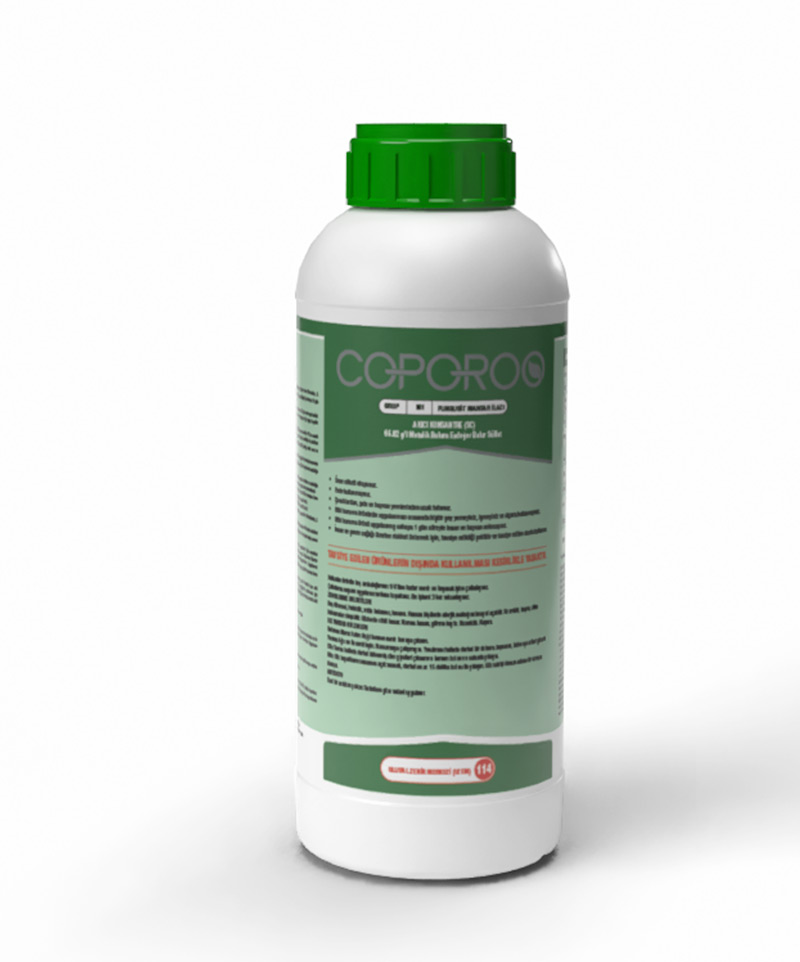
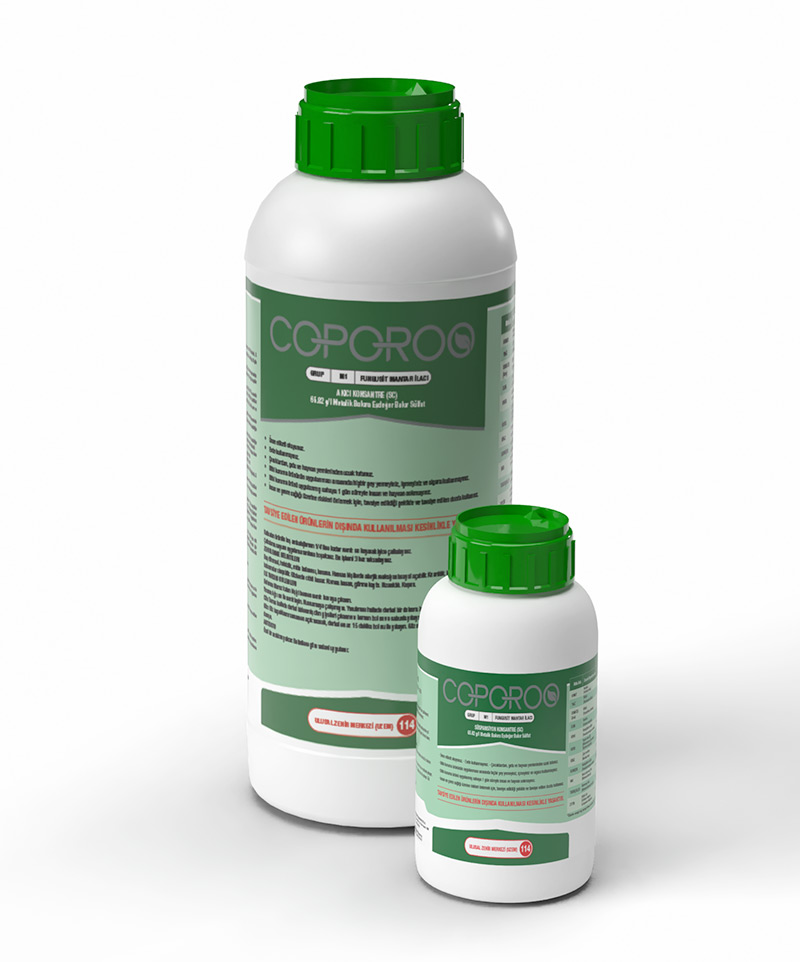
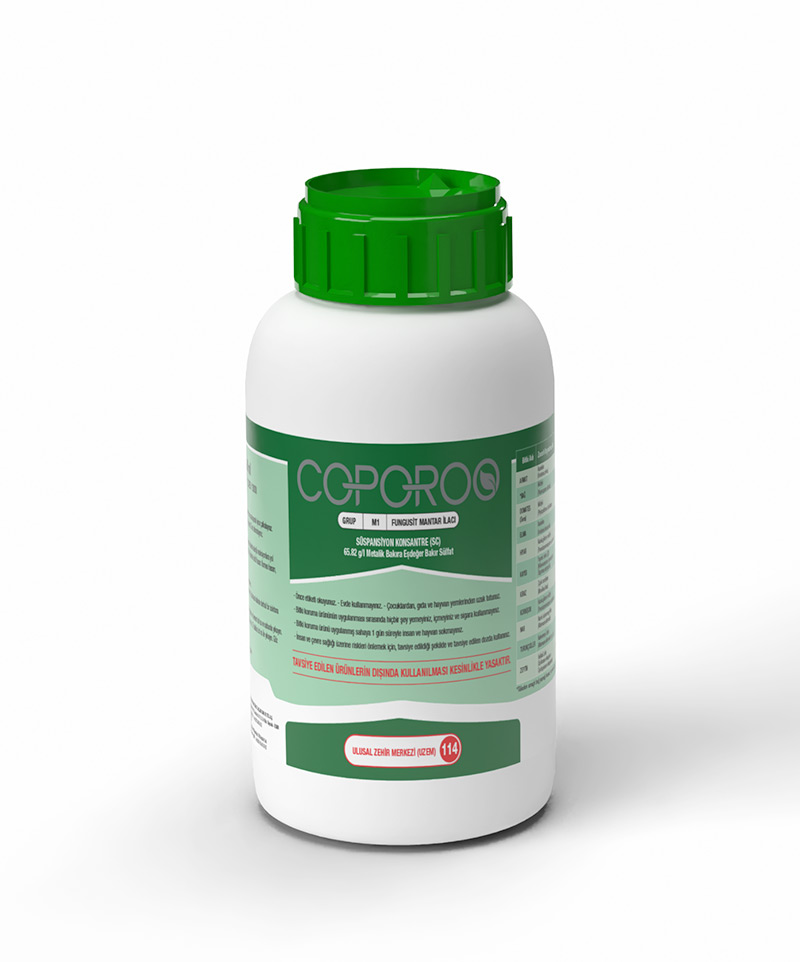
COPOROO® is a new and unique fungicide containing high-quality copper sulfate, developed with superior formulation technology.
It contains copper sulfate equivalent to 65.82 g of metallic copper per liter.
COPOROO® is effective against many fungal diseases by preventing the germination of disease spores in the fungal cell.
COPOROO® contains copper ions with a very small molecular diameter.
Thus, it provides better coverage on the leaf surface and in the soil.
Due to its high biological efficacy, it provides maximum effect and benefit with a minimum amount of product.
| PRODUCT NAME | : | COPOROO® |
|---|---|---|
| GROUP | : | M1 |
| DESCRIPTION | : | FUNGICIDE |
| ACTIVE INGREDIENT | : | Copper Sulfate Equivalent to 65.82 g/l Metallic Copper |
| PACKAGING | : | 1 LT |
Preparation of the Plant Protection Product for Application
The plant protection product, calculated over the recommended dose, is first mixed with some water in a separate container. The tank of the application machine is filled halfway with water. While the mixer of the machine is operating, the prepared mixture is added to the tank. Continuing to mix, the tank is completely filled with water.
The mixing process must be continued during the application. Use the prepared plant protection product on the same day.
For mildew recommendation in tomatoes, 50 L of water should be used for application per decare.
Calibration
Calibration of the machine must be done before the application. In applications, the mixture amount should be adjusted to provide a good coverage. pplications should be made in the cool hours of the day, in windless or slightly windy weather conditions.
Pesticide Norm
In tomato fields, the pesticide norm can be taken in the range of 300–600 L/ha for disease and pest applications. For weed applications, this amount can be applied as 200–400 L/ha.
Cleaning of the Application Machine
Immediately after the application is completed, the tank of the application machine must be emptied safely. After filling the tank with clean water, the mixer and spraying system should be operated to ensure all parts are washed. Washing operations should not be carried out near water sources, and washing water and waste must not be discharged into water sources.
Cleaning of Empty Packages
Fill the empty packages of the used product up to 1/4 with clean water and shake thoroughly.
Empty the rinsing water into the application tank. Repeat this process 3 times.
Symptoms of Poisoning
- Dizziness
- Fatigue
- Nausea, vomiting
- Allergic reactions in sensitive individuals
- Skin redness, itching, blistering
- Severe damage to eyes, corneal damage, loss of vision
Pear Scab
- 1st Application: When flower buds swell (3–5 days earlier in areas with branch canker)
- 2nd Application: At white rosette stage
- 3rd Application: When 70–80% of flower petals have fallen
- 4th and Subsequent Applications: Every 10 days when weather conditions are favorable.
Grape Downy Mildew
- 1st Application: When shoots reach 25–30 cm
- 2nd and Subsequent Applications: 15 days after the first application, continued when conditions such as temperature–rainfall–humidity are suitable.
Tomato Late Blight
In areas where the disease occurs every year, application should begin before symptoms appear when the daily average temperature reaches 16°C and relative humidity reaches 80%.
In areas where the disease does not occur every year, application should begin when the first symptoms are observed in the field.
In the Black Sea Region, timing is determined using accumulated temperature–humidity–rainfall values over consecutive 15 days.
Apple Scab
- 1st Application: When flower buds swell (3–5 days earlier in areas with branch canker)
- 2nd Application: At pink flower bud stage
- 3rd Application: When 70–80% of flower petals have fallen
- 4th and Subsequent Applications: Every 10 days under suitable weather conditions
Downy Mildew in Cucumber, Gherkin, and Cucurbits
Application should begin when plants start vining or when the first symptoms of downy mildew are observed, and should continue at 7–10 day intervals.
The application must cover all parts of the plant, especially the underside of leaves.
Shot Hole Disease in Apricot
- 1st Application: Immediately after leaf fall in autumn
- 2nd Application: Before flower buds open in spring
- 3rd Application: When the calyx and stamen table separate from the fruit
Cherry Blossom Blight (Monilia)
- 1st Application: At the beginning of flowering (5–10% bloom)
- 2nd Application: At full bloom (90–100% bloom)
Pomegranate Brown Spot
- 1st Application: When flower buds swell (3–5 days earlier in areas with branch canker)
- 2nd Application: When petals fall
- 3rd Application: When the fruit reaches half size
Citrus Brown Spot
Application begins when shoots reach 5–10 cm and the first symptoms are observed. Applications end when shoot growth stops, rainfall decreases, and fruit reaches approximately 4 cm in diameter.
Olive Peacock Spot
Marmara Region
- Before autumn shoots appear
- Before flower clusters become visible
Aegean Region
- Before autumn shoots appear
- Before spring shoots appear
- Before flower clusters become visible
Mediterranean Region
- After harvest
- Before spring shoots appear
- Before flower clusters become visible
Note: All applications should be carried out before or immediately after rainfall.
Resistance Information
COPOROO® is a Group M1 Fungicide according to its mode of action.
Repeated use of products from the same group increases the risk of resistance.
The recommended total number of applications per season should not be exceeded, and when reapplication is required, products with different modes of action should be used alternately.
Tank-Mix Compatibility
COPOROO® is not recommended to be mixed with other plant protection products.
Directions for Use
COPOROO® should be applied a maximum of 2 times during the season and at 14-day intervals.
| Plant Name | Harmful Organism | Application Dose | Pre-Harvest Interval (Days) |
|---|---|---|---|
| PEAR | Scab (Venturia pirina) |
125 ml / 100 L water | 21 Days |
| *VINEYARD | Downy Mildew (Plasmopara viticola) |
50 ml / 100 L water | 21 Days |
| TOMATO (Greenhouse) | Late Blight (Phytophthora infestans) |
100 L water 150 ml / 100 L water Per decare: 75 ml / da** |
14 Days |
| APPLE | Scab (Venturia inaequalis) |
150 ml / 100 L water | 21 Days |
| CUCUMBER | Downy Mildew in Cucurbits (Pseudoperonospora cubensis) |
100 ml / 100 L water | 14 Days |
| APRICOT | Shot Hole (Leaf Spot) (Wilsonomyces carpophylus = Stigmina carpophila) |
125 ml / 100 L water | 21 Days |
| CHERRY | Blossom Blight (Monilinia laxa) |
125 ml / 100 L water | 21 Days |
| GHERKIN | Downy Mildew in Cucurbits (Pseudoperonospora cubensis) |
100 ml / 100 L water | 14 Days |
| POMEGRANATE | Brown Spot in Pomegranate (Alternaria alternata) |
125 ml / 100 L water | 21 Days |
| CITRUS | Brown Spot (Alternaria alternata f.sp. citri) |
250 ml / 100 L water | 21 Days |
| OLIVE | Peacock Spot (Spilocaea oleagina = Cyclogonium oleaginum) |
125 ml / 100 L water | 21 Days |
*Cannot be used in vineyards where grape leaves are harvested for consumption.