
ARGONIK 80 WDG
WATER DISPERSIBLE GRANULES (WDG)
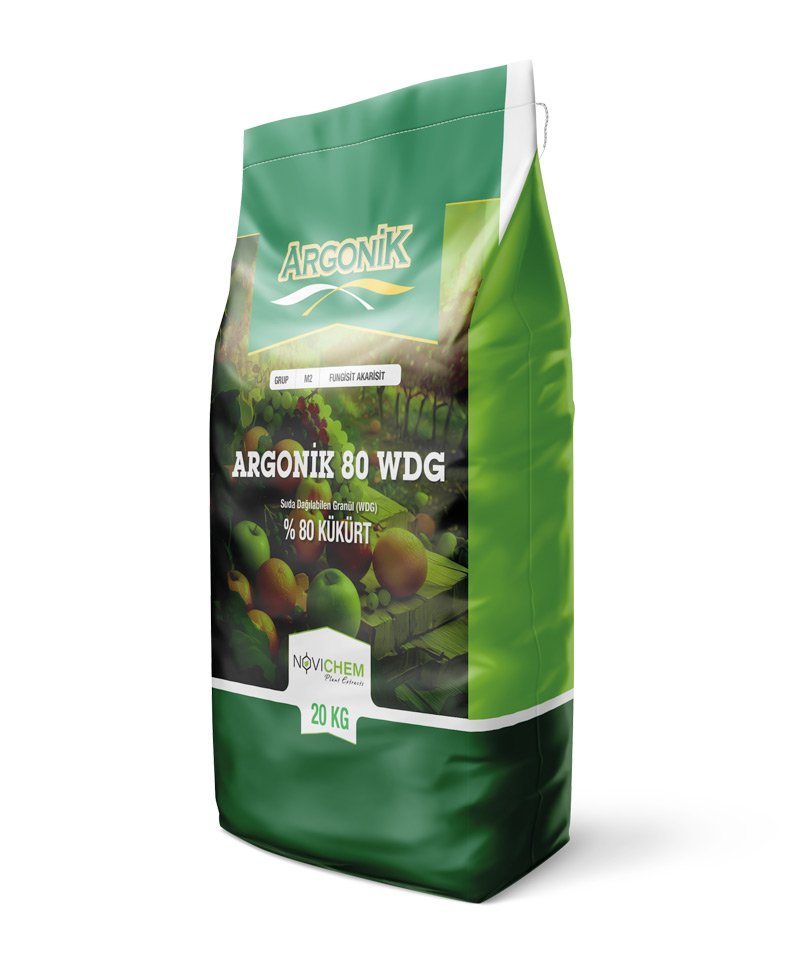
ARGONIK 80 WDG fungicides containing 80% sulfur are contact-acting protective plant protection products widely used in crop production. Sulfur is a natural element effective against both fungi (fungal diseases) and mite pests.
When sulfur comes into contact with the plant surface, it evaporates, preventing the development of fungal spores and stopping spore germination. At the same time, it forms a protective layer on the plant surface, preventing disease agents from entering the leaf and fruit tissue.
| PRODUCT NAME | : | ARGONIK 80 WDG® |
|---|---|---|
| GROUP | : | M2 |
| DESCRIPTION | : | FUNGICIDE ACARICIDE |
| ACTIVE INGREDIENT | : | 80% Sulfur |
| PACKAGING | : | 800 g / 20 kg |
Advantages
- Natural element origin, environmentally friendly
- Low risk of resistance development
- Dual action against mites and fungi
- Disperses well on the plant surface, providing long-lasting persistence
- Can be used in organic farming (depending on certification)
H315: Causes skin irritation.
H319: Causes serious eye irritation.
P101: If medical advice is needed, have product container or label at hand.
P102: Keep out of reach of children.
P264: Wash hands, arms, and face thoroughly with soap and water after handling.
P280: Wear protective gloves, protective clothing, eye protection, face protection.
P305+P351+P338: IF IN EYES: Rinse cautiously with water for several minutes. Remove contact lenses, if present and easy to do. Continue rinsing.
P321: Specific treatment required (see label).
P501: Dispose of contents/container at approved waste collection facilities.
EUH401: To avoid risks to human health and the environment, comply with the instructions for use.
General symptoms of poisoning may occur.
General: Seek medical advice in case of doubt or if symptoms persist.
If inhaled: Move the person to fresh air and ensure comfortable breathing.
If on skin: Wash skin thoroughly with plenty of water. Remove contaminated clothing. If irritation occurs, seek medical attention.
If in eyes: Rinse cautiously with water for several minutes. Remove contact lenses if present and easy to do. Continue rinsing. Seek medical attention if irritation persists.
If swallowed: Do not give anything by mouth to an unconscious person. Do not induce vomiting. If unwell, call a poison center or doctor.
There is no specific antidote. Treatment is applied according to symptoms.
Do not dispose of containers into the environment, lakes, streams, or sewage systems. Deliver to authorized local disposal facilities.
Based on the recommended dose, mix the product in a separate container with some water. Fill the sprayer tank halfway with water, add the mixture while the agitator is running, then complete the tank with water. Keep mixing during application. Use the prepared solution the same day.
Calibration: Before application, calibrate the sprayer. Adjust the mixture amount to ensure full coverage. Apply during cool and calm weather conditions.
Spray Volume: In apple orchards, use 25–50 L/da for dwarf varieties, 25–100 L/da for semi-dwarf varieties, and 20–150 L/da for tall varieties.
ARGONIK 80 WG is classified as a Group M2 fungicide based on its mode of action. Repeated use of plant protection products with the same mode of action encourages resistance development. Do not exceed the recommended number of applications within the same season. When repeated treatment is required, use products with a different mode of action (other than Group M2).
Do not mix with other plant protection products.
After the application is completed, safely empty the tank. Fill with clean water and run the agitator and spraying system to wash all parts. Do not wash near water sources. Do not discharge rinse water and waste into water resources.
- Store the product container tightly closed and out of reach of children.
- Always follow protective measures during application.
- After application, remove clothing and wash hands, face, and body with plenty of water.
- Toxic to bees. Do not use during flowering period.
- Toxic to fish. Do not contaminate surface or groundwater sources.
Under normal (cool and dry) conditions and stored unopened in the original packaging, the product maintains its physical, chemical, and biological properties for 2 years within acceptable tolerance limits.
We guarantee the quality of the product if stored under normal conditions in unopened original packaging. We do not accept responsibility for damage resulting from improper storage or failure to follow application instructions and recommendations.
Grape powdery mildew:
1st application: When the shoots are 25–30 cm long before flowering.
2nd application: During the pre-flowering stage when flower buds are separated.
3rd application: When flower petals fall off and the berries reach the size of small shot grains.
4th and subsequent applications: According to the duration of the product’s effectiveness, until the berries enter the bunch-closure stage.
Grape blister mite: Since the product used against grape powdery mildew also controls this pest, no separate application is required.
Apple powdery mildew:
1st application: At pink flower bud stage.
2nd application: When 60–70% of flower petals have fallen.
3rd and subsequent applications: Continue applications as long as favorable conditions for the disease persist, considering the product’s residual activity.
Peach powdery mildew:
1st application: Determined according to the disease severity in previous years. Start application as soon as the first symptoms are observed.
2nd and subsequent applications: Continue applications until infection conditions disappear, considering plant growth and the residual period of the product.
Rose powdery mildew: The first application should be made when leaf and bud formation begins. The entire plant surface must be thoroughly covered.
Begonia powdery mildew: Start application when the first symptoms appear on the leaves and repeat weekly.
Powdery mildew in cucumber and cucurbit crops: Start when the first symptoms appear. Interrupt applications if the average daily temperature exceeds 27°C and relative humidity falls below 50%.
Onion downy mildew: Chemical control is applied during active vegetation. Applications should begin when the average daily temperature reaches 16°C and relative humidity reaches 80%, or when the first symptoms are observed in the field.
Chickpea anthracnose: Foliar applications should begin when the average temperature reaches 10°C and relative humidity is at least 80%, or practically when the first symptoms are observed in the field. If heavy rain occurs on the day of application, treatment should be repeated.
Bean rust: Applications should begin once rust pustules are observed on bean leaves. Continue applications based on disease severity, weather conditions, and product persistence. Treatment is not required during pod ripening in dry beans as it does not cause economic loss.
Citrus red mite: Start application before the pest moves to fresh shoots, preferably before flowering. If missed, treatment can be done one week after fruit set. Do not apply early in the morning with dew or during hot weather.
Citrus bud mite: In infested orchards, apply when spring shoots are 8–10 cm long; the most suitable period is late March to early April. Repeat application 20–25 days later.
| Plant Name | Target Organism | Application Dose |
|---|---|---|
| Vine* | Grape Powdery Mildew (Erysiphe necator) |
400 g/100 L water |
| Grape Leaf Blister Mite (Eriophyes vitis) |
490 g/100 L water | |
| Apple | Powdery Mildew (Podosphaera leucotricha) |
400 g/100 L water |
| Peach | Powdery Mildew (Sphaerotheca pannosa var. persicae) |
400 g/100 L water |
| Rose | Powdery Mildew (Sphaerotheca pannosa var. rosae) |
400 g/100 L water |
| Begonia | Powdery Mildew (Microsphaera begoniae) |
300–350 g/100 L water |
| Chickpea | Anthracnose (Ascochyta rabiei) |
300 g/100 L water |
| Onion | Onion Downy Mildew (Peronospora destructor) |
300 g/100 L water |
| Bean | Bean Rust (Uromyces appendiculatus) |
300 g/100 L water |
| Cucumber | Powdery Mildew in Cucurbits (Erysiphe cichoracearum = Podosphaera xanthii) |
400 g/100 L water 200 g/da |
| Citrus | Citrus Red Mite (Panonychus citri) |
600 g/100 L water |
| Citrus Bud Mite (Aceria sheldoni) |
600 g/100 L water |